
Why Am I Struggling to Build Muscle After 30? Here’s What Needs to Change.
You used to train, see results quickly and build muscle without overthinking it. Now you’re training around work, family and everything else life throws at you, skipping sessions, guessing your workouts and wondering why your physique isn’t changing.
Sound familiar?
First, let’s get one thing straight. Turning 30 doesn’t suddenly mean you can’t build muscle, get stronger or improve your body composition.
Age is not an automatic excuse to accept declining standards or give up on your physique.
But your circumstances may have changed. Your recovery might be different, your stress levels may be higher, your sleep may be worse and you probably have less time to spend in the gym.
The problem isn’t necessarily your age. It’s trying to use the same approach when your life, priorities and recovery capacity have changed.
If you want to build muscle after 30, you need a training and nutrition strategy that fits the life you actually live.
Here’s what to focus on.
1. Stop Relying on Random Workouts to Build Muscle.
When you first started training, almost anything could produce noticeable progress.
You were relatively new to lifting, your body was adapting to a new stimulus, and simply training consistently could lead to improvements in muscle size and strength.
But as you become more experienced, progress requires a more deliberate approach.
Walking into the gym and making up your workout as you go might leave you feeling like you’ve worked hard. That doesn’t necessarily mean you’ve done what’s needed to build muscle.
Muscle growth requires progressive overload.
In simple terms, your training needs to provide a stimulus that develops over time. That might mean lifting more weight, completing more reps with the same weight, improving your technique or getting more out of the same exercise.
If you’re constantly changing exercises, guessing your weights and forgetting what you did last week, how can you accurately judge whether you’re progressing?
You can’t manage what you don’t measure.
What should you do instead?.
Build a structured workout programme that:
Uses exercises you can perform consistently and safely.
Gives you a clear number of sets and rep ranges.
Records your weights and reps.
Allows you to track progress from week to week.
Fits the time you can realistically commit to training.
You don’t need a complicated programme full of exercises you’ve seen on social media.
You need a plan you can execute, measure and improve.
2. Train With Enough Intensity, Not Just More Volume.
One of the biggest mistakes I see is people confusing doing more work with getting better results.
Three, four, five or six sets of an exercise might look impressive on paper. But if the first few sets are nowhere near challenging enough, are they really giving you the best return on your time?
For muscle growth, your working sets need to be sufficiently challenging.
That doesn’t mean every set needs to end in complete failure. It means understanding how hard you’re working, using appropriate technique and getting close enough to your limits to stimulate progress.
For many exercises, finishing a set with around one to three good reps left in reserve can be an effective approach. Some exercises and training phases may benefit from different levels of effort.
The important point is that your sets have a purpose.
Two high-quality, challenging sets can be more productive than several poorly executed sets. The right amount of volume depends on the individual, exercise, training experience and ability to recover.
More is not automatically better.
If you’re adding sets without improving performance, accumulating fatigue without a clear reason or spending hours in the gym without measurable progress, it’s time to reassess your training.
Train hard. Track it. Recover from it. Then aim to improve.
3. Get Your Protein Intake Right.
You can have the best training programme in the world, but if your nutrition doesn’t support your goal, you’re making the process harder than it needs to be.
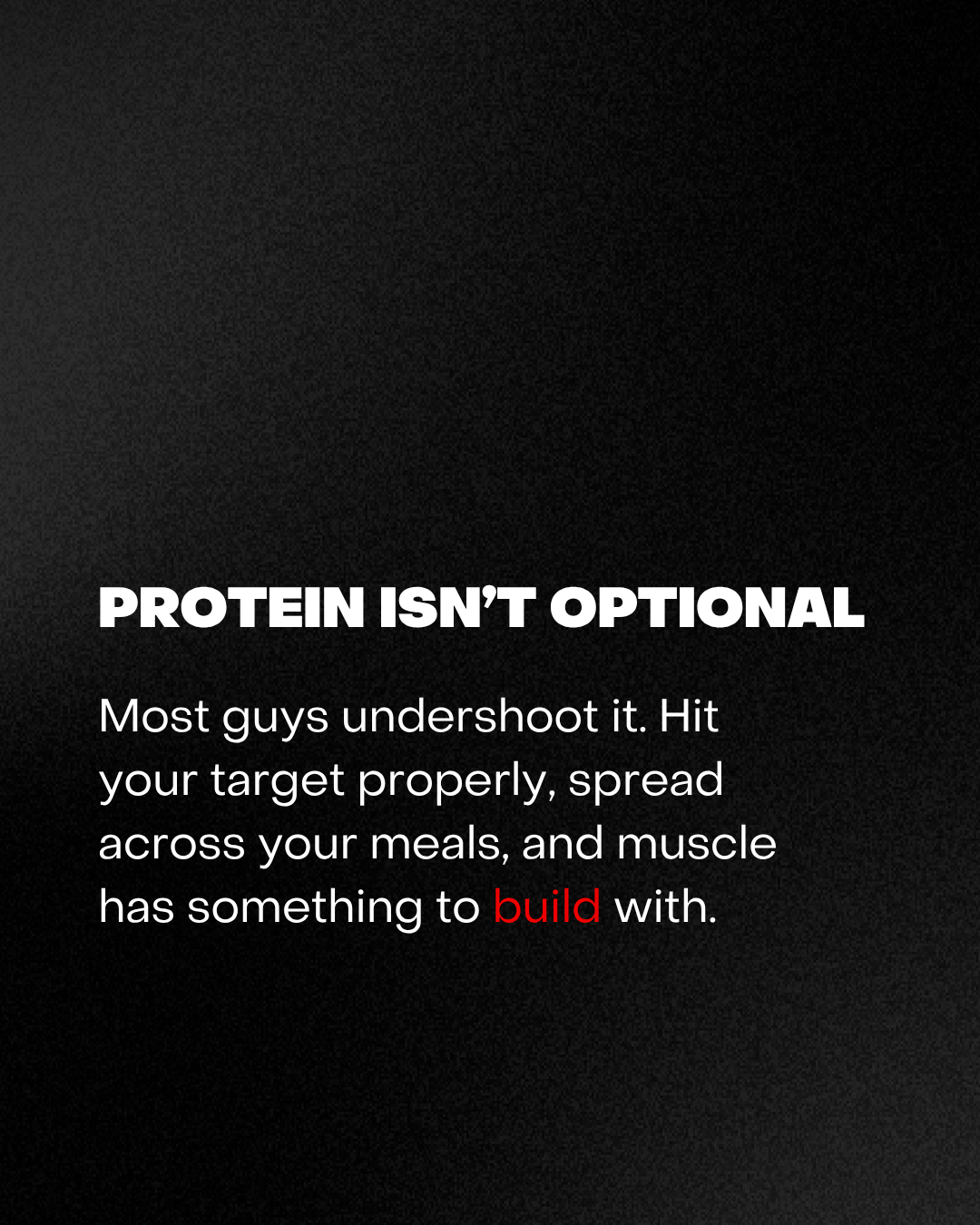
Protein provides the amino acids your body needs to repair and build muscle tissue. If you’re consistently under-eating protein, you may be missing a key part of your muscle-building strategy.
This becomes especially important if you’re trying to lose body fat while maintaining or building muscle.
Many men assume they eat plenty of protein because they have meat with dinner. But when you look at their full day of eating, breakfast might contain very little, lunch might be whatever they can grab between meetings, and most of their protein comes in one evening meal.
That makes it harder to hit an appropriate daily target consistently.
How much protein do you need to build muscle?.
A useful evidence-based starting point for most healthy adults who train regularly is approximately 1.6–2.2 grams of protein per kilogram of body weight per day.
Your ideal intake will depend on factors such as your body composition, calorie intake, training and goals. If you have a medical condition that affects protein requirements, seek advice from an appropriate healthcare professional.
Rather than trying to cram all your protein into one meal, spread it across the day.
Practical options include:
Eggs or Greek yoghurt at breakfast.
Chicken, lean beef, fish, tofu or another protein source at lunch.
A protein-rich snack when your schedule makes a full meal difficult.
A balanced evening meal containing a substantial protein source.
You don’t need to make nutrition unnecessarily complicated. Start by knowing your target, planning your meals and hitting it consistently.
4. Your Recovery Is Part of the Training Plan.
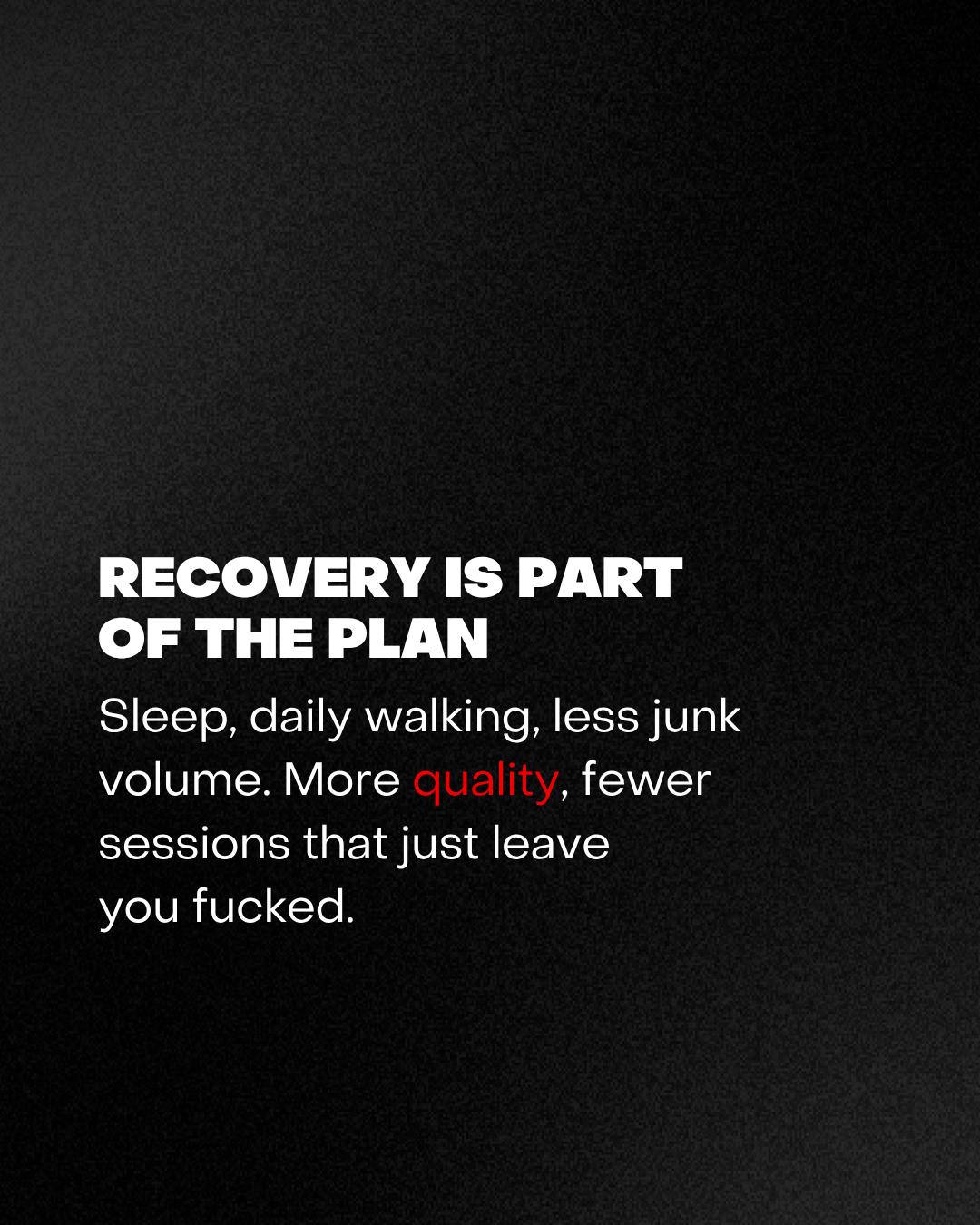
Training is the stimulus. Recovery helps you adapt to it.
Yet sleep, stress and daily activity are often the first things to suffer when life gets busy.
You might be working longer hours, managing a business, looking after your family and trying to fit training around everything else. You may also be sleeping less, moving less during the day and relying on convenience food more often.
None of that means you can’t make progress.
It does mean you need to be more intentional about how you manage your recovery.
Sleep matters.
Poor sleep can negatively affect training performance, recovery, appetite regulation and your ability to maintain consistent habits.
Aim for seven to nine hours of sleep where possible, and establish a routine that gives you a realistic chance of getting enough.
You can’t expect to repeatedly sacrifice sleep and then wonder why your training feels harder.
Daily movement matters.
Your workouts are only one part of your overall activity.
If you spend most of the day sitting at a desk, in meetings or driving, your daily movement may be much lower than you think.
Walking more consistently is a straightforward way to increase daily activity without adding another demanding gym session to your schedule.
More training isn’t always the answer
If you’re constantly exhausted, your performance is dropping and every workout feels like a battle, adding more volume may be the wrong move.
Sometimes the better approach is to reduce unnecessary work, improve sleep, manage stress and make your existing sessions more productive.
The goal isn’t to see how much punishment you can tolerate. It’s to apply enough training stimulus to progress, then recover well enough to do it again.
5. “I Don’t Have Time” Usually Means Your Plan Needs to Change
You don’t need to spend five hours in the gym every week to build muscle.
You need a realistic plan that you can follow consistently.
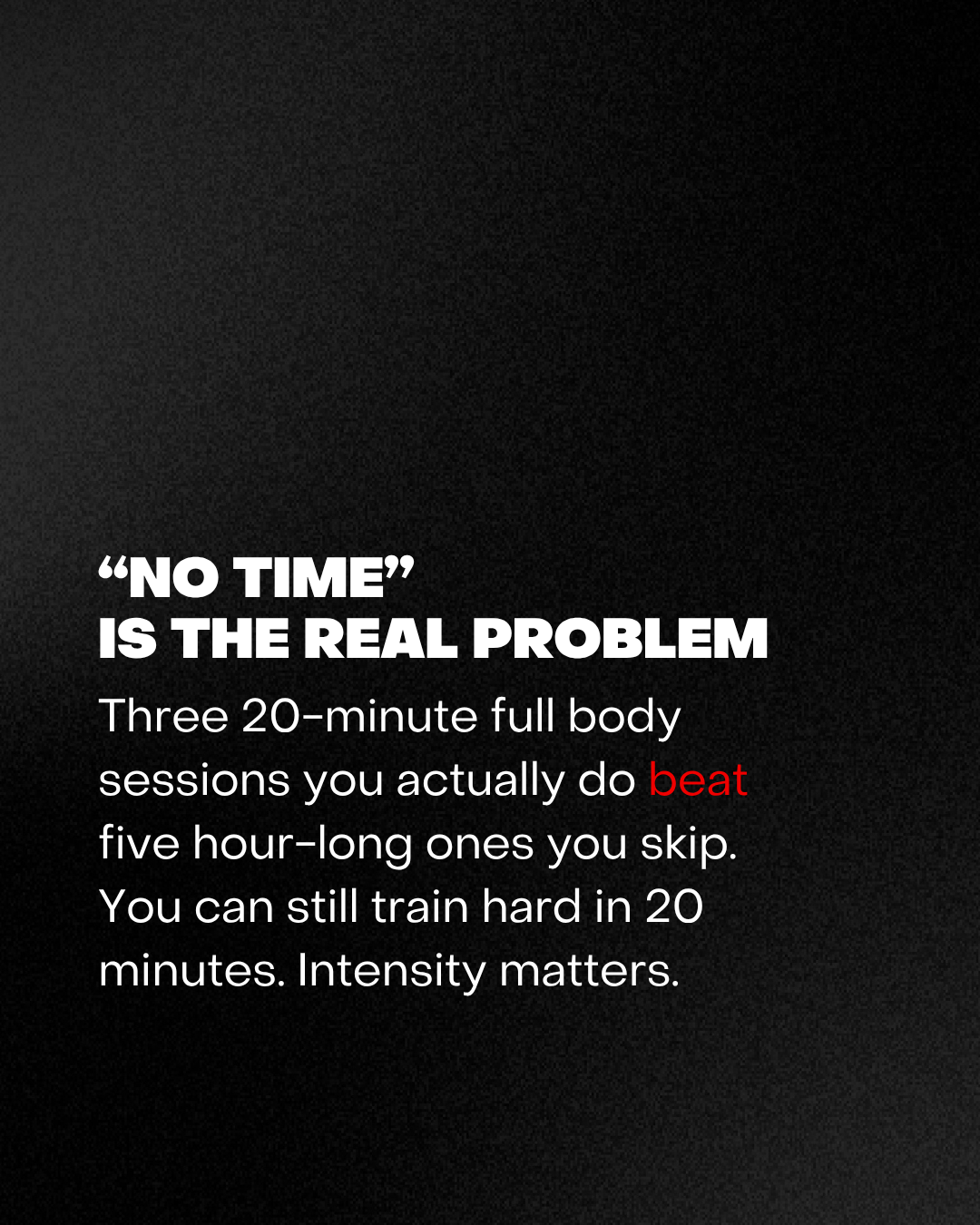
For a busy professional, business owner or dad, three focused 20–45-minute sessions may be a far better starting point than planning five long workouts that rarely happen.
The exact amount of training you need depends on your goals, experience, available equipment and recovery. But the principle remains the same: a programme you complete consistently beats an ideal programme you repeatedly abandon.
How to train when you’re busy.
Start with these principles:
Schedule your sessions: Treat them as appointments rather than something you’ll do if you have time.
Prioritise productive exercises: Use movements that train major muscle groups efficiently.
Keep a record: Know your exercises, weights, reps and progression targets.
Have a minimum viable session: If your usual hour disappears, have a shorter version you can complete instead.
Stop chasing perfection: One shortened workout is better than turning a busy day into a missed week.
You don’t need to reorganise your entire life around the gym.
You need training that works within your life while still challenging you enough to get results.
6. Stop Judging Progress by How You Look Every Day.
Building muscle takes time. Changes in body weight, hydration, food intake and fatigue can make your physique look different from one day to the next.
If you judge your progress solely by the mirror after every workout, you’ll struggle to see the bigger picture.
Instead, track several indicators:
Strength and performance in the gym.
Body weight trends over time, if relevant to your goal.
Waist measurements and progress photographs.
Training consistency.
Energy levels and recovery.
How your clothes fit and how you feel day to day.
Not every measure will move in the same direction at the same time. For example, if you’re losing body fat while building muscle, the scales may not change dramatically even while your body composition improves.
Look for trends rather than demanding visible results every week.
And if nothing is changing over a sustained period, don’t automatically assume you need to work harder. Review the programme, training effort, nutrition, recovery and adherence first.
7. Your Training Plan Should Reflect Your Life Now.
The approach that worked at 22 might not be the best approach at 35, 40 or 50.
That doesn’t mean your potential has disappeared.
It means your strategy needs to account for the reality of your current circumstances.
You may have less free time, more responsibilities and greater demands on your attention. You may need to be more deliberate about recovery and more organised with your nutrition.
That’s not a reason to lower your standards.
It’s a reason to stop relying on guesswork.
A structured programme, appropriate training intensity, sufficient protein, better recovery and consistent execution can take you a long way, provided they’re matched to your needs and adjusted as you progress.
This is also where having a coach can make a difference.
Not because you’re incapable of learning how to train, but because building a plan, assessing progress, identifying what’s holding you back and adapting your approach can be difficult to manage objectively on your own.
Good coaching gives you structure, accountability, feedback and a strategy that evolves with you.
Ready to Build Muscle and Get Your Progress Moving Again?.
If you’re over 30, juggling work and family, and frustrated because your training no longer produces the results you expect, you don’t necessarily need to train more.
You need to understand what’s missing and put a better plan in place.
At All Round Coaching, I help men build muscle, lose body fat and improve their body composition through structured training, practical nutrition and coaching that fits around real life.
No random workouts. No unnecessary complexity. No relying on motivation to carry you through.
Just a clear plan, consistent execution and adjustments based on your progress.
If you’re ready to stop guessing and start making meaningful progress, complete the two-minute quiz through the link on my website to find out how we can work together.
Your age isn’t automatically the problem. Your approach might be.
Let’s fix that.
